

Last updated: May 16, 2026
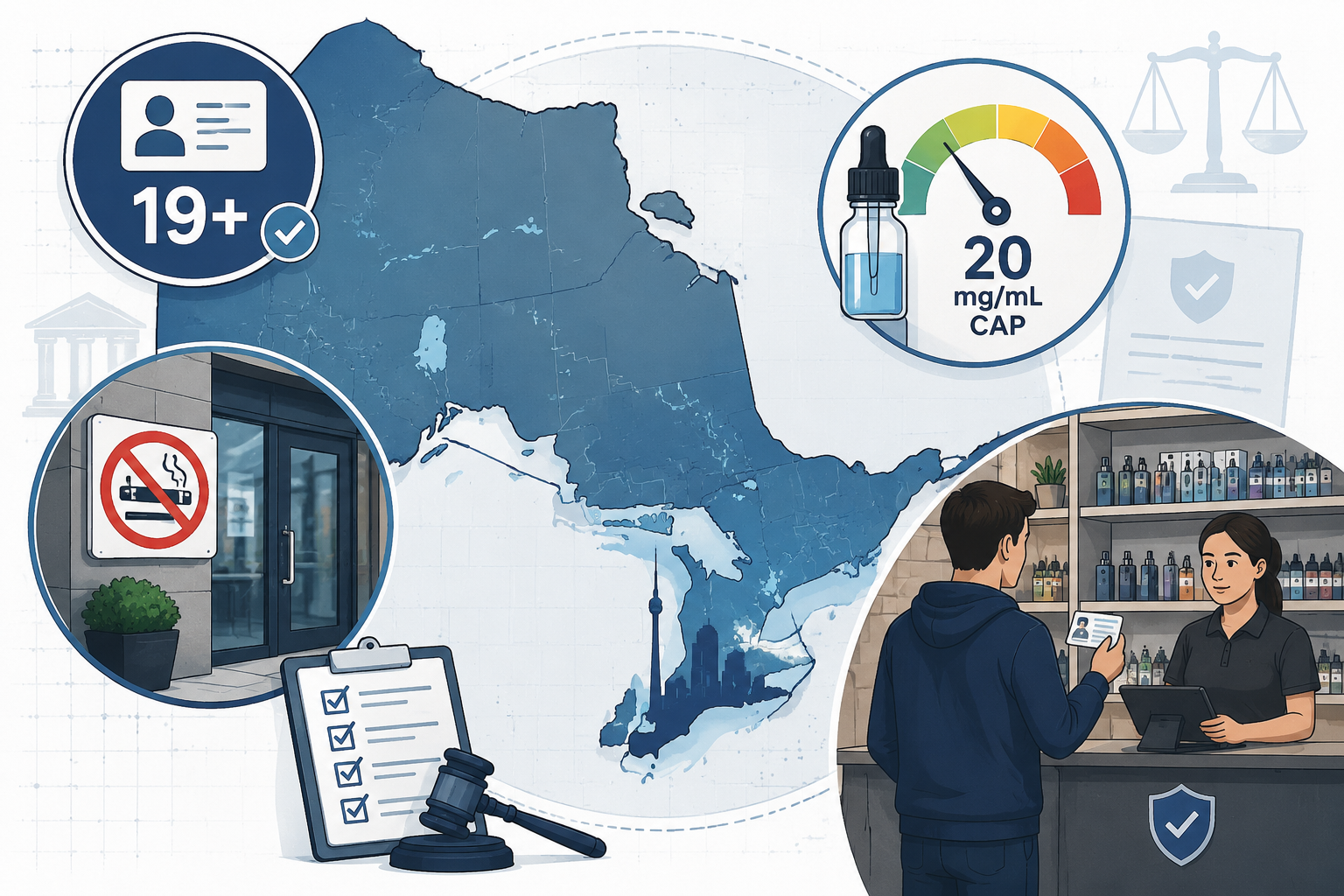
Ontario requires anyone purchasing or using vape products to be at least 19 years old. Nicotine vape liquid is capped at 20 mg/mL under federal rules, and the province bans vaping in most enclosed public spaces and workplaces under the Smoke-Free Ontario Act, 2017. Retailers must verify age at the point of sale, and advertising restrictions limit how and where vape products can be promoted.
Key Takeaways
- Minimum age is 19 in Ontario for buying, possessing, or using any vape product.
- Nicotine concentration is federally capped at 20 mg/mL for all vaping substances sold in Canada.
- Vaping is banned in enclosed public places, enclosed workplaces, and within 9 metres of building entrances or exits under provincial law.
- Flavour bans have not been enacted provincially as of May 2026, though federal proposals have been discussed.
- Retailers face fines starting at $1,000 for a first offence of selling to someone under 19, and up to $100,000 for subsequent offences.
- Online sales require age verification at both the point of purchase and the point of delivery.
- Display and promotion restrictions apply: vape products generally cannot be displayed where minors can see them in retail settings.
- Cannabis vape products fall under separate legislation (the Cannabis Act) with additional restrictions.
- No provincial licensing system currently exists for vape retailers, but municipal business licences may apply.
- Penalties apply to individuals too: adults who supply vape products to minors can face personal fines.
What Are the Core Vaping Laws in Ontario in 2026?
Ontario’s vaping regulations come from two layers of government: federal law (which controls product standards and packaging) and provincial law (which controls where you can vape, who can buy, and how products are sold). Both apply simultaneously.
Provincial law: Smoke-Free Ontario Act, 2017 (SFOA)
This is the main provincial statute. Key rules include:
- Age restriction: No person shall sell or supply vapour products to anyone under 19.
- Use restrictions: Vaping is prohibited in all enclosed public places, enclosed workplaces, schools, childcare centres, hospitals, and other designated spaces.
- 9-metre rule: No vaping within 9 metres of entrances and exits of enclosed public places and workplaces.
- Display restrictions: Retailers cannot promote vape products in a way visible from outside the store. Products must be kept behind the counter or in closed cabinets in most settings.
Federal law: Tobacco and Vaping Products Act (TVPA) and Vaping Products Labelling and Packaging Regulations
- Nicotine cap: Maximum 20 mg/mL for all vaping substances.
- Packaging: Plain packaging requirements, health warnings, and restrictions on flavour-related imagery.
- Advertising: Lifestyle advertising and advertising that could appeal to young persons is prohibited.
- Ingredients: Certain additives (like vitamins and caffeine) are banned in vaping liquids.
Common mistake: Many adults assume that because they can legally buy vape products, they can use them anywhere. Ontario’s SFOA treats vaping nearly the same as smoking in terms of where it’s allowed. Using a vape inside a restaurant, bar, or office can result in a fine.
For a broader look at the Canadian vape market and what’s driving product trends, see the rise of disposable vapes in Canada and why they’re popular in 2026.
Who Do These Laws Apply To? Understanding the 19+ Age Requirement
Every person in Ontario who buys, uses, or sells vape products must comply with the 19+ age requirement. This applies equally to residents and visitors.
Here’s what the age rule covers:
| Action | Legal at 19+? | Legal under 19? |
|---|---|---|
| Purchasing vape products | Yes | No |
| Possessing vape products | Yes | No |
| Using vape products in permitted areas | Yes | No |
| Supplying vapes to someone under 19 | No (illegal) | No (illegal) |
| Entering a vape specialty shop | Yes | No |
Who enforces it? Provincial tobacco enforcement officers, municipal bylaw officers, and in some cases police can enforce age-related vaping laws. Retailers are the front line: they must ask for government-issued photo ID from anyone who appears to be under 25.
Edge case: What about 18-year-olds from other provinces? Alberta and Quebec set their minimum age at 18 for tobacco and vaping products. But Ontario law applies within Ontario’s borders. An 18-year-old from Alberta visiting Toronto cannot legally purchase or use vape products in Ontario.
If you’re new to vaping and want to understand the basics, this guide explains what disposable vapes are in straightforward terms.
Where Can Adults Legally Vape in Ontario?
Adults 19+ can vape in private residences (subject to landlord rules), outdoors in most public spaces (if more than 9 metres from building entrances), and in designated vaping areas where they exist.
Places where vaping is prohibited under the SFOA:
- Enclosed workplaces
- Enclosed public places (malls, restaurants, bars, theatres)
- Schools and school grounds (public and private, K-12)
- Childcare centres and playgrounds
- Hospitals and healthcare facilities
- Public transit vehicles and shelters
- Common areas of condos and apartment buildings (varies by building rules)
- Within 9 metres of entrances/exits of any enclosed public place or workplace
- Restaurant and bar patios (added under SFOA amendments)
- Sporting areas and spectator areas
- Ontario government buildings and grounds
Where vaping is generally permitted:
- Inside a private home (unless a lease or condo bylaw says otherwise)
- Outdoors, away from restricted zones
- Inside a personal vehicle (but not if anyone under 16 is present, per SFOA)
- Designated vaping rooms in certain workplaces or long-term care homes (rare, with strict ventilation requirements)
Decision rule: If you wouldn’t light a cigarette there, don’t vape there. Ontario’s law treats the two almost identically for location-based restrictions.
Municipal bylaws can add more restrictions. Toronto, Ottawa, and other cities have passed additional bylaws that extend smoke-free and vape-free zones to parks, beaches, and outdoor public spaces. Always check local rules.
What Are the Rules for Buying Vape Products in Ontario?
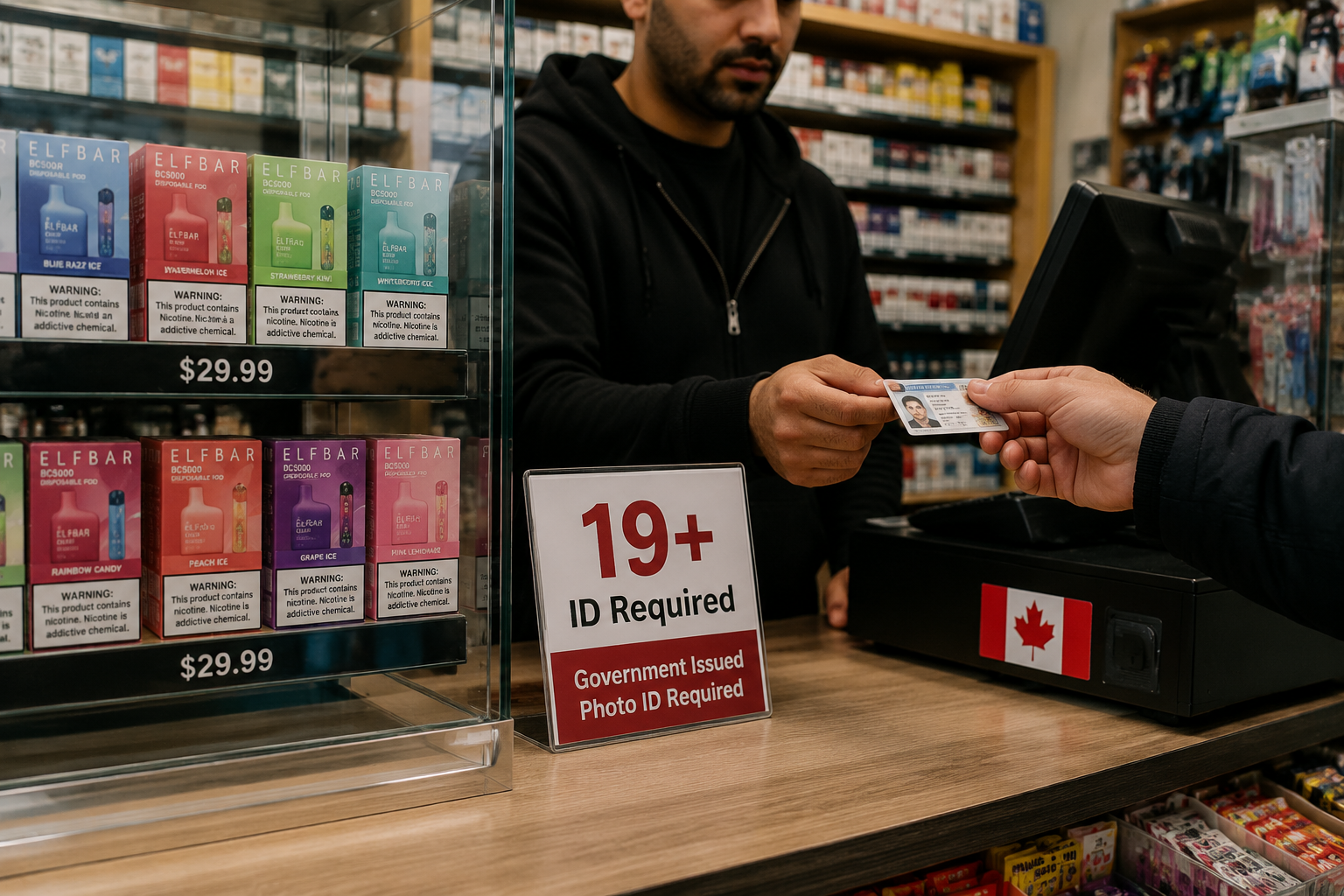
Adults 19+ can buy vape products from licensed retailers, vape specialty shops, and online stores that comply with age verification requirements.
In-store purchases
- Retailers must verify age with government-issued photo ID.
- Vape products cannot be sold from vending machines.
- Products must be stored behind the counter or in a closed display case (not accessible to customers in most retail formats).
- Specialty vape shops (where minors are not allowed to enter) have slightly more flexibility on product display.
Online purchases
Federal and provincial rules require:
- Age verification at checkout (date of birth confirmation, and increasingly, third-party age verification services).
- Age verification at delivery (the person receiving the package must show ID proving they are 19+).
- Shipping restrictions: Products cannot be shipped to addresses associated with schools, childcare centres, or other prohibited locations.
For adults shopping for affordable options online, this roundup of disposable vapes under $20 in Ontario covers what’s available within legal price ranges.
Product standards that affect what you can buy
| Regulation | Requirement |
|---|---|
| Nicotine concentration | Maximum 20 mg/mL |
| Tank/pod capacity | No federal limit, but products must comply with labelling rules |
| Packaging | Plain packaging with health warnings covering at least 75% of display surfaces |
| Flavours | Currently legal in Ontario (no provincial flavour ban as of May 2026) |
| Ingredients | No vitamins, caffeine, or certain other additives |
Common mistake: Buying vape products from unlicensed sources or across the U.S. border. Products that exceed the 20 mg/mL nicotine cap or don’t meet Canadian labelling requirements are illegal to sell in Canada, and importing them can result in seizure at the border.
How Do Vaping Laws in Ontario 2026 Affect Retailers and Businesses?
Retailers face strict obligations around age verification, product display, advertising, and record-keeping. Non-compliance carries escalating fines.
Fines for retailers
| Offence | First Offence | Subsequent Offences |
|---|---|---|
| Selling to a minor | Up to $1,000 | Up to $100,000 |
| Failing to post required signage | Up to $1,000 | Up to $5,000 |
| Improper product display | Up to $1,000 | Up to $50,000 |
| Allowing vaping in a prohibited area (for business owners) | Up to $1,000 | Up to $100,000 |
Advertising restrictions
Under both federal and provincial law:
- No lifestyle advertising (showing vaping as glamorous, social, or associated with a particular lifestyle).
- No advertising that could appeal to youth (cartoon characters, candy-like branding, etc.).
- Point-of-sale promotion is limited. Signs must be factual, not promotional.
- Online advertising must include age-gating and cannot target users under 19.
What businesses should do
- Train all staff on age verification procedures.
- Post required signage about the 19+ age minimum.
- Keep vape products behind the counter or in closed cases.
- Maintain records of supplier compliance with federal product standards.
- Stay updated on municipal bylaws that may add local requirements.
Retailers looking to stock compliant products can find guidance in how to choose the best wholesale vape supplier in Ontario, which covers what to look for in terms of regulatory compliance.
What Changed in Ontario’s Vaping Regulations Recently?
The most significant recent change was the federal nicotine cap reduction to 20 mg/mL, which took effect in 2021 and continues to shape the market in 2026. Provincial enforcement has also intensified.
Timeline of key changes
- 2015-2018: Vaping was largely unregulated in Canada. The federal Tobacco and Vaping Products Act (TVPA) received Royal Assent in May 2018.
- 2020: Ontario updated the SFOA to include vaping products more explicitly, adding restrictions on where vaping is allowed and tightening retail display rules.
- 2021: Health Canada’s Vaping Products Labelling and Packaging Regulations came into force, including the 20 mg/mL nicotine cap and plain packaging requirements.
- 2023-2024: Increased enforcement actions across Ontario, with more tobacco enforcement officers conducting compliance checks at retail locations.
- 2025-2026: Federal consultations on potential flavour restrictions continued. As of May 2026, no federal or provincial flavour ban has been enacted, but the topic remains under active discussion.
What to watch for: Health Canada has signalled interest in further restricting flavoured vaping products. If a federal flavour ban is enacted, it would override any provincial allowance. Ontario adults who prefer flavoured products should stay informed about these developments.
For current product options that comply with Canadian regulations, this list of the best disposable vapes in Canada for 2026 is a useful reference.
How Do Ontario’s Laws Compare to Other Canadian Provinces?
Ontario’s vaping laws are moderately strict compared to other provinces. Some provinces have gone further with flavour bans or additional retail restrictions.
| Province | Minimum Age | Flavour Restrictions | Nicotine Cap | Additional Notes |
|---|---|---|---|---|
| Ontario | 19 | None (provincial) | 20 mg/mL (federal) | Strong display and advertising rules |
| British Columbia | 19 | Provincial flavour restrictions enacted | 20 mg/mL | Limits on some flavoured products |
| Quebec | 18 | Provincial flavour restrictions enacted | 20 mg/mL | Stricter advertising rules |
| Alberta | 18 | None (provincial) | 20 mg/mL | Less restrictive retail environment |
| Nova Scotia | 19 | Flavour ban in effect | 20 mg/mL | One of the strictest provinces |
| Manitoba | 18 | None (provincial) | 20 mg/mL | Moderate restrictions |
Key takeaway: Ontario sits in the middle. It has a higher minimum age than Alberta, Quebec, and Manitoba (19 vs. 18), but it hasn’t enacted provincial flavour restrictions like Nova Scotia, Quebec, or British Columbia. The federal 20 mg/mL nicotine cap applies everywhere.
What About Cannabis Vape Products in Ontario?
Cannabis vape products are legal for adults 19+ in Ontario but are regulated separately under the Cannabis Act and the Ontario Cannabis Store (OCS) framework, not the SFOA.
Key differences:
- Where to buy: Legal cannabis vape products can only be purchased from licensed cannabis retail stores or the OCS online store. They cannot be sold in convenience stores or regular vape shops.
- THC limits: Cannabis vape cartridges and disposables are subject to federal THC concentration limits.
- Where to use: Cannabis vaping is subject to the same location restrictions as cannabis smoking under Ontario’s Cannabis Control Act, 2017, which largely mirrors the SFOA’s smoke-free zones but adds some additional restrictions (e.g., in vehicles, near schools).
- Packaging: Cannabis vape products must follow strict Cannabis Act packaging rules, which are even more restrictive than nicotine vape packaging.
Don’t confuse the two: A regular vape shop cannot sell cannabis vape products. A cannabis retail store cannot sell nicotine vape products. The regulatory systems are entirely separate.
What Are the Penalties for Breaking Vaping Laws in Ontario?
Penalties range from $305 fixed fines for individuals vaping in prohibited areas up to $100,000 for repeat-offence retailers selling to minors.
For individuals
| Violation | Penalty |
|---|---|
| Vaping in a prohibited area | Set fine of $305 (can be higher if contested and found guilty at trial) |
| Supplying vape products to a minor | Fine up to $4,000 (first offence), up to $25,000 (subsequent) |
| Underage purchase attempt | Generally not penalized for the minor; enforcement focuses on the seller |
For retailers and businesses
Fines escalate significantly for repeat offences, as shown in the retailer fines table above. In addition:
- Licence suspension or revocation: Municipalities that require business licences for vape retailers can suspend or revoke those licences for non-compliance.
- Product seizure: Enforcement officers can seize products that don’t comply with federal standards.
- Court orders: In serious cases, courts can order a business to close temporarily.
Practical tip: If you receive a fine you believe is unjust, you have the right to dispute it in provincial court. But the burden of proof for age verification falls on the retailer, so keeping thorough records is essential.
How to Stay Compliant: A Checklist for Ontario Vapers and Retailers
For adult vapers (19+)
- Always carry government-issued photo ID when purchasing vape products
- Only buy from licensed, compliant retailers or verified online stores
- Check that products display proper Health Canada warnings and don’t exceed 20 mg/mL nicotine
- Respect all smoke-free and vape-free zones
- Never supply vape products to anyone under 19
- Check local municipal bylaws for additional restrictions in your area
- Dispose of used vape products properly (many contain lithium batteries that shouldn’t go in regular trash)
For tips on product lifespan and disposal, this guide on telling when a disposable vape is near the end is worth reading.
For retailers
- Verify age for every transaction (ask for ID if the customer appears under 25)
- Post all required signage at the point of sale
- Keep vape products behind the counter or in closed display cases
- Ensure all products meet federal labelling and nicotine concentration standards
- Train staff regularly on compliance procedures
- Document compliance efforts (training records, supplier certifications)
- Monitor for updates to federal and provincial regulations
Businesses sourcing products should also review the complete guide to selling wholesale disposable vapes in Canada for supply chain compliance details.
Frequently Asked Questions
Can I vape on a restaurant patio in Ontario? No. Ontario’s SFOA prohibits vaping on restaurant and bar patios. This applies to all enclosed and partially enclosed patios, and many open-air patios as well depending on municipal bylaws.
Is it legal to order vapes online and have them shipped to Ontario? Yes, as long as the seller complies with federal and provincial age verification requirements. Age must be verified at checkout and again at delivery. The products must meet Canadian standards (20 mg/mL nicotine cap, proper labelling).
Are flavoured vapes banned in Ontario? No. As of May 2026, Ontario has not enacted a provincial flavour ban. Flavoured vaping products remain legal to sell and purchase. However, federal consultations on flavour restrictions are ongoing, and this could change.
Can my landlord ban vaping in my apartment? Yes. Landlords in Ontario can include no-vaping clauses in lease agreements. Condominium corporations can also pass bylaws restricting vaping in units and common areas. The SFOA already prohibits vaping in common areas of multi-unit residential buildings.
What ID is accepted for purchasing vape products? Any government-issued photo ID that shows date of birth: Ontario driver’s licence, Ontario photo card, Canadian passport, or other provincial/territorial photo ID. Health cards are not acceptable as ID for age verification in Ontario retail settings.
Can I bring vape products into Ontario from another country? Products for personal use may be brought in, but they must comply with Canadian regulations. Products exceeding 20 mg/mL nicotine or containing banned ingredients can be seized by the Canada Border Services Agency. There is no duty-free allowance specifically for vape products like there is for tobacco.
Are there restrictions on vaping in a car? You cannot vape in a vehicle if anyone under 16 is a passenger. This applies whether the vehicle is moving or parked. There is no general ban on vaping while driving, but distracted driving laws could apply if the act of vaping impairs your ability to drive safely.
Do vape shops need a special licence in Ontario? Ontario does not have a provincial vape retailer licensing system as of 2026. However, municipalities may require a business licence, and some have created specific licence categories for vape retailers. Check with your local municipal government.
What is the maximum nicotine strength I can legally buy in Ontario? 20 mg/mL. This is a federal limit set by Health Canada’s Vaping Products Labelling and Packaging Regulations. It applies across all of Canada, not just Ontario.
Can I vape in Ontario parks? It depends on the municipality. Provincial parks generally follow SFOA rules (no vaping in enclosed structures, 9-metre rule from buildings). Many municipalities, including Toronto, have extended vape-free zones to include public parks and beaches. Always check local signage and bylaws.
Are disposable vapes legal in Ontario? Yes. Disposable vapes are legal as long as they meet all federal product standards, including the 20 mg/mL nicotine cap, proper labelling, and plain packaging requirements. For help choosing a product, see how to choose the right disposable vape.
Conclusion
Ontario’s vaping laws in 2026 balance adult access with public health protections. The rules are straightforward once you understand the two-layer system: federal standards control what products can exist in Canada, and provincial law controls who can buy them, where they can be used, and how they can be sold.
Three actionable steps for Ontario adults 19+:
- Know the location rules. Treat vaping like smoking when deciding where to use your device. When in doubt, step outside and move 9 metres from any building entrance.
- Buy from compliant sources. Stick to retailers and online stores that verify age and sell products with proper Health Canada labelling. If a product doesn’t have a health warning on the package, it likely doesn’t meet Canadian standards.
- Stay informed. Federal flavour restrictions and additional provincial measures are under active discussion. Following Health Canada announcements and Ontario government updates will help you avoid surprises.
The regulatory environment is still evolving. What’s legal today regarding flavours or product types could change with new federal regulations. Staying current is the best way to ensure continued compliance and access to the products you prefer.
References
- Government of Ontario. Smoke-Free Ontario Act, 2017. Ontario.ca. https://www.ontario.ca/laws/statute/17s26
- Health Canada. Tobacco and Vaping Products Act (S.C. 2018, c. 9). Justice Laws Website, 2018. https://laws-lois.justice.gc.ca/eng/acts/T-11.5/
- Health Canada. Vaping Products Labelling and Packaging Regulations (SOR/2019-353). Canada Gazette, 2019 (amendments in force 2021). https://laws-lois.justice.gc.ca/eng/regulations/SOR-2019-353/
- Government of Ontario. Rules for selling tobacco and vapour products. Ontario.ca. https://www.ontario.ca/page/rules-selling-tobacco-and-vapour-products
- Government of Ontario. Where you can’t smoke or vape in Ontario. Ontario.ca. https://www.ontario.ca/page/where-you-cant-smoke-or-vape-ontario